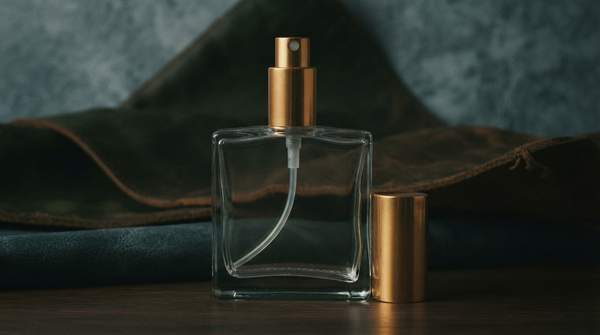
A fragrance does not simply fade—it transforms. The citrus brightness you smell at application gives way to florals or spice, and hours later you are left with woods and musk. The reason is chemistry: each ingredient evaporates at a different rate, determined by its molecular weight and structure. Light, small molecules escape the skin first; heavier, structurally complex molecules linger for hours. Understanding this principle turns the familiar "fragrance pyramid" from marketing shorthand into a physical explanation.
The Fragrance Pyramid: An Introduction to Scent Evolution
Perfumers describe a fragrance's structure as a pyramid: volatile top notes at the peak, heart notes in the middle, and long-lasting base notes at the foundation. The Perfumer's Apprentice, a fragrance-supply company, explains that this structure is deliberately balanced so that scents unfold gradually, creating a transition from one layer to the next rather than an abrupt switch. The pyramid is not a physical arrangement of the liquid—everything is mixed together—but a timeline of perception. As one layer of molecules evaporates, the next becomes dominant to the nose.
Molecular Volatility: The Engine of Scent Change
The driving force is volatility: how quickly a compound evaporates. A chemistry resource from Hong Kong Baptist University's chemistry department explains that heat from the skin causes perfume molecules to gradually evaporate and diffuse into the air, where they reach the nose. Each molecule evaporates according to its own volatility, so the ingredients leave the skin in a predictable sequence. As Pura's fragrance chemistry explainer puts it, volatility is "the key to a balanced scent," with high volatility producing light, quick scents like lemon and mint, medium volatility producing heart notes like rose and cinnamon, and low volatility producing slow, deep notes like patchouli and sandalwood.
The Fragrance Evolution Model: From Molecule to Scent
The table below links each layer's molecular properties to its evaporation behavior and the scent you actually perceive. The causal chain runs in one direction: molecular weight and structure determine volatility, volatility determines evaporation order, and evaporation order determines what you smell at each hour.
| Note Layer | Volatility & Evaporation | Molecular Properties | Perceived Scent & Duration |
|---|---|---|---|
| Top Notes | Highest volatility; evaporate quickly, providing the initial burst | Light molecules, often with short aliphatic chains; examples include linear-chain aldehydes and aromatic compounds like citral | Fresh scents such as citrus and light herbs; roughly 30 minutes to 1 hour on skin |
| Heart Notes | Moderate volatility; emerge as top notes fade | Heavier and more complex than top notes; examples include β-ionone and hydrogen-bond-forming alcohols such as geraniol, citronellol, and 2-phenylethanol; esters also contribute here | Floral, spicy, or green aromas forming the body of the fragrance; typically 2–6 hours |
| Base Notes | Lowest volatility; evaporate very slowly | Large, heavy, structurally complex molecules such as muscone and civetone; often act as fixatives | Woods, musk, vanilla; noticeable from about 30 minutes after application and lasting 6–8 hours or longer |
Structure matters as much as weight. A Perfumer & Flavorist article on structure–odor relationships reports that short straight aliphatic chains—one to five carbon atoms—produce light, fresh smells, while medium chains of six to ten carbons shift toward green and citrus notes, and longer chains of eleven to thirteen carbons yield fatty notes. In other words, adding carbons to a chain makes a molecule heavier and slower to evaporate, and simultaneously changes what it smells like.
Top Notes: The Initial Impression
Top notes are the most volatile ingredients in the bottle. Hong Kong Baptist University's chemistry resource identifies linear-chain aldehydes among the most volatile molecules contributing to the top of the fragrance. Because these molecules are light and small, skin heat liberates them within minutes. This is why the opening of a cologne—citrus, herbs, sharp freshness—is also the first thing to disappear. Molton Brown's guide to fragrance notes gives top notes a lifespan of roughly 30 minutes to an hour on skin, which is why a cologne sprayed in a store can smell entirely different by lunchtime.
Heart Notes: The Core of the Fragrance
Once the lightest molecules have evaporated, moderately volatile compounds take over. The HKBU resource points to β-ionone and hydrogen-bond-forming alcohols like geraniol, citronellol, and 2-phenylethanol as typical heart-note molecules—larger and more structurally intricate than top-note aldehydes. Hydrogen bonding raises their boiling points, slowing evaporation. According to the Perfumer's Apprentice, heart notes determine a perfume's overall character and typically dictate its fragrance family, whether floral, oriental, or woody. They last roughly 2 to 6 hours and form the bridge between the bright opening and the dry-down.
Base Notes: The Lasting Foundation
Base notes come from the heaviest, least volatile molecules—HKBU's resource names muscone and civetone, large cyclic molecules that cling to skin for hours. The Perfumer's Apprentice notes that base notes typically become noticeable about 30 minutes after application and can last 6 to 8 hours or longer, with sandalwood, patchouli, vanilla, and musk as common examples. Their low volatility is a direct consequence of high molecular weight and structural complexity: more mass and more internal attractions mean more energy is required to escape into the air. This is the "dry-down" that remains on a shirt collar the next morning.
Perfumery's Engineering: Controlling the Scent Journey
The sequence is not left to chance. Perfumers use fixatives—often base notes themselves—to slow the evaporation of lighter molecules. HKBU's resource explains that fixatives interact favorably with volatile top-note molecules to delay their evaporation, with civetone, muscone, and galaxolide serving this role. The Perfumer's Apprentice adds that base notes "help to fix the more volatile top and middle notes, extending the overall wear time." Preservation goes beyond timing: HKBU notes that antioxidants are added to prevent limonene and linalool from oxidizing into hydroperoxides, which can cause contact allergic reactions, while UV-absorbers such as oxybenzone protect molecules from sunlight damage. The scent journey is engineered, not accidental.
Engineering Your Scent Experience
Understanding the molecular science behind fragrance notes allows for a more informed appreciation and selection of perfumes, recognizing that the scent journey is a carefully engineered process. The practical takeaway: judge a fragrance over hours, not seconds. The perceived change in scent profile over several hours, from initial fresh notes to a lasting deep aroma, indicates the successful interplay of molecular volatilities and fixatives. A cologne that smells only of its top notes at the counter may reveal its true character—its heart and base—only after the first hour on your own skin.