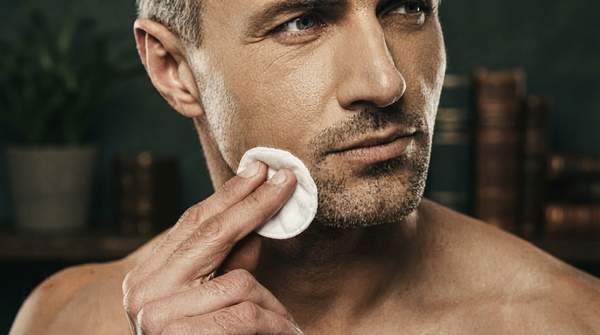
The best exfoliant for a man's skin is the one matched to his skin type and primary concern: oil-soluble beta hydroxy acids (BHAs) for oily, breakout-prone skin; water-soluble alpha hydroxy acids (AHAs) for dullness, uneven tone, and dryness; and gentler polyhydroxy acids (PHAs) for sensitive skin. Physical scrubs deliver immediate smoothing but carry a higher risk of irritation if used roughly. The decision framework below maps each option to specific skin profiles, followed by a safe routine for putting it into practice.
Understanding Exfoliation: Physical vs. Chemical
Exfoliation is simply the removal of dead skin cells from the skin's surface. These cells naturally accumulate over time, and as skincare brand RATIONALE explains, that buildup contributes to dullness, congestion, and uneven texture. Every exfoliation method—physical or chemical—aims to clear that buildup; what differs is the mechanism and the risk profile.
Physical exfoliation, often called the traditional method, uses tools or granular substances such as scrubs, microbeads, or cleansing brushes to manually lift away dead cells. Chemical exfoliation takes a different route: ingredients like alpha hydroxy acids and beta hydroxy acids dissolve the bonds that hold dead cells together, allowing them to be gently released from the surface. RATIONALE frames the distinction as the difference between "an act of damaging abrasion" and a biologically supportive process, which is why the brand formulates exclusively with chemical exfoliants.
That framing comes from a company selling chemical exfoliants, but the underlying mechanics are widely described across sources. Physical scrubs provide immediate smoothing, while chemical options can be gentler and more effective at unclogging pores, according to beauty retailer bluemercury's guidance for men. The practical takeaway: physical exfoliation works, but its abrasive nature means it can cause micro-tears and irritation if not used gently, and it demands more care from the user.
The Science of Chemical Exfoliants: AHAs, BHAs, and PHAs
Chemical exfoliants fall into three main classes, and their behavior is dictated by two properties: solubility and molecular size. These determine where the acid works—on the surface or inside the pore—and how deeply it penetrates.
AHAs (alpha hydroxy acids) are water-soluble acids that dissolve the bonds between surface skin cells. Because they cannot travel through oil, they work primarily on the skin's outermost layer, making them well suited to concerns that live at the surface: dullness, uneven tone, fine lines, and dryness. Common examples are glycolic acid, the more potent of the two, and lactic acid, which is milder and hydrating—RATIONALE notes lactic acid is ideal for dry or sensitive skin.
BHAs (beta hydroxy acids) are oil-soluble, which is the decisive property. Unlike AHAs, they can penetrate through sebum and travel into the pore, where they unclog congestion at its source. Salicylic acid is the most common BHA, and this class is best suited to oily, acne-prone skin, blackheads, and preventing breakouts. For men whose chief complaint is shine, clogged pores, or recurring spots, this solubility difference is what makes BHAs the better fit.
PHAs (polyhydroxy acids) are the gentlest of the three. Their larger molecular size means they exfoliate the skin's surface without penetrating as deeply as AHAs or BHAs, which reduces the likelihood of irritation while still offering hydrating and antioxidant benefits. They are the natural starting point for men with sensitive or reactive skin who still want the results of chemical exfoliation.
Exfoliant Selection Guide for Men's Skin
The framework below maps the properties of each exfoliant class—solubility, penetration depth, and gentleness—to the skin profiles men most commonly want to address. To use it, find the row that best matches your skin type and primary concern, then look to the recommended exfoliant class and ingredient examples. The reasoning is straightforward: match the acid's chemistry to where your problem lives. Surface concerns like dullness call for water-soluble AHAs; pore-level concerns like oil and blackheads call for oil-soluble BHAs; sensitive skin calls for the larger-molecule, gentler action of PHAs.
| Exfoliant Type | Mechanism / Solubility | Primary Skin Concerns | Key Ingredient Examples | Suitability Notes |
|---|---|---|---|---|
| Physical exfoliants | Manually scrubs away dead cells with abrasive particles or tools | Immediate surface smoothing | Scrubs, microbeads, cleansing brushes | Can cause micro-tears and irritation if not used gently; stronger scrubs may suit oilier complexions |
| AHAs | Water-soluble; dissolves bonds between surface cells | Dullness, uneven tone, fine lines, dryness | Glycolic acid (more potent); lactic acid (milder, hydrating) | Work on the surface; lactic acid suits dry or sensitive skin |
| BHAs | Oil-soluble; penetrates deep into pores | Oily skin, acne, blackheads, breakouts | Salicylic acid | Ideal for targeting oil and congestion within the pore |
| PHAs | Larger molecules; gentle surface exfoliation | Sensitive or reactive skin | Gluconolactone-type PHAs | Less penetration reduces irritation; hydrating and antioxidant benefits |
Two boundary cases deserve mention. Men with normal or combination skin can reasonably start with a mild AHA, since their concerns usually span both surface dullness and occasional congestion. And this guide addresses routine skincare, not medical conditions—severe acne or suspected rosacea warrant a dermatologist rather than a product aisle.
Safe Exfoliation Practices: Integrating into Your Routine
Choosing the right exfoliant is only half the equation; using it correctly determines whether you get smoother, clearer skin or an irritated barrier. The first principle is fit: bluemercury's guidance for men notes that some exfoliators are designed for daily use while others should only be used once or twice a week to avoid over-exfoliating and irritating the skin. Check the product's intended frequency rather than assuming more is better.
Start gradually. If you are new to chemical exfoliants, begin with a lower concentration and less frequent use—one or two sessions per week—then observe how your skin responds before increasing. This is especially important with glycolic acid, the more potent AHA, and with any physical scrub, where pressure and technique matter as much as the product itself.
Learn to recognize over-exfoliation. Persistent redness, tightness, flaking, stinging, or increased sensitivity are signals to scale back or pause entirely. RATIONALE's standard is a useful benchmark: improvements in clarity and texture should come without flaking. If your skin is reacting rather than adapting, you are doing damage, not exfoliating.
Finally, protect what you have uncovered. Because exfoliation promotes skin cell turnover and reveals newer, fresher cells, the newly exposed skin needs diligent follow-up care—moisturizer to support the barrier and, critically, sunscreen, since freshly exfoliated skin is more vulnerable to sun exposure. Skipping this step undermines the entire routine.
Achieving Smoother, Clearer Skin: Your Next Steps
Select an exfoliant type (physical, AHA, BHA, or PHA) that aligns with your specific skin type and concerns, and integrate it into your routine gradually and safely. Concretely: identify your profile in the matrix above, choose the matching ingredient class, start at low frequency and concentration, and pair every session with moisturizer and daily sunscreen. The measurable indicator of success is reduced dullness, clearer pores, smoother skin texture, and absence of irritation after consistent, appropriate use. If those signs appear over the following weeks, your match is right; if irritation appears instead, step down to a gentler class—many men find a PHA or lactic acid works where glycolic acid or a scrub did not.