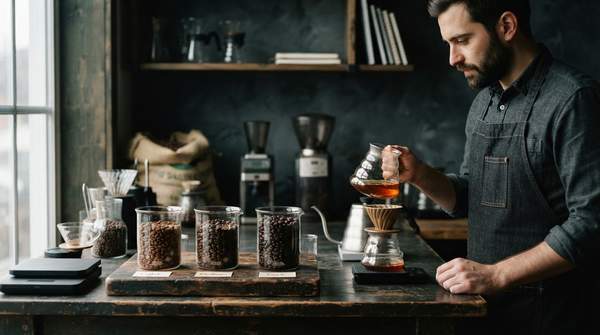
Roast level is the single biggest lever a roaster pulls on a coffee's flavor, and it reshapes how the bean behaves in your brewer. Light, medium, and dark roasts differ not just in color but in chemistry: the Maillard reaction builds nutty, savory notes, caramelization adds sweetness and bitterness, and acid degradation and carbonization mute brightness while deepening body. Those same reactions change how soluble the bean is, which means your grind size and water temperature should shift with the roast.
The Roasting Journey: From Green Bean to Flavorful Brew
Raw coffee beans contain complex carbohydrates, proteins, acids, and oils that change dramatically under heat, as Kaleido Roasters explains in its breakdown of roast-level science. Roasting pushes green beans through two audible milestones: first crack, when internal bean temperatures reach roughly 180–205°C and the beans pop and expand, and second crack, the threshold into dark-roast territory.
One principle frames everything that follows: roasting reveals flavors already present in the green bean rather than inventing them. As Jim Morton writes for Liberty Beans Coffee, "Roasting isn't flavor creation — it's flavor revelation through controlled destruction. Every second past first crack trades origin nuance for roast-derived character."
The Chemistry of Coffee Roasting: Maillard, Caramelization, and Pyrolysis
Three overlapping reactions drive the transformation. The Maillard reaction, active between roughly 300–350°F (150–175°C), produces hundreds of flavor compounds responsible for caramel, nutty, and bready notes. Caramelization follows at 350–420°F (175–215°C), breaking down sugars to create both sweetness and bitterness. Pyrolysis takes over beyond about 420°F (215°C), driving carbonization that contributes the smokiness associated with dark roasts.
Acids degrade on their own schedule. Liberty Beans Coffee cites sucrose beginning to caramelize around 165°C (329°F), producing furans and maltol that contribute perceived sweetness. By 196°C (385°F), chlorogenic acids break down into quinic and caffeic acids, increasing perceived bitterness and astringency as the roast deepens. The balance among these reactions, as Kaleido Roasters puts it, determines whether a coffee tastes bright and complex or bold and smoky.
Coffee Roast Levels: Chemistry, Flavor, and Brewing Guide
The table below correlates each roast level's dominant chemistry with its flavor outcome, physical structure, and the brewing adjustments that follow. Read across a row to see the causal chain: reactions determine solubility, and solubility determines how you should grind and heat your water.
| Roast Level | Dominant Chemistry | Flavor Profile | Physical Bean Changes | Brewing Adjustments |
|---|---|---|---|---|
| Light | Maillard reactions initiated; limited caramelization and acid degradation, preserving many original compounds | Bright acidity; fruity, floral, delicate origin-specific notes with savory, nutty, or bready undertones from early Maillard reactions | Denser, less porous, harder structure; retains more moisture; less soluble than well-developed roasts | Finer grind (fine-medium, like table salt) and higher water temperatures (200–205°F) to compensate for low solubility |
| Medium | Maillard well-developed; prominent sugar caramelization; chlorogenic acids beginning to break down | Balanced acidity and sweetness; caramel-like flavors, chocolatey undertones, medium body | More porous than light roasts but less brittle than dark; considered the most soluble roast level | Medium grind and moderate water temperatures — between the light and dark roast recommendations — for balanced extraction |
| Dark | Extensive acid degradation; carbohydrate carbonization (pyrolysis); caffeine slightly reduced by heat | Low acidity, heavy body; bold, smoky notes with chocolate, toasted nuts, and sometimes burnt sugar | Highly porous and brittle; oils migrate to the surface, giving a glossy appearance; faster extraction | Coarser grind (medium-coarse, like sea salt) to keep an already-soluble, fast-extracting coffee from over-extracting |
Note that the fruity and floral notes in a light roast are largely preserved from the green bean — roasting protects them rather than creating them — while the Maillard reaction supplies the savory undertones. And as Scott Rao observes from his own extraction work, very dark roasting can actually decrease solubility by burning off some of the bean's soluble mass, with well-developed light-to-medium roasts extracting most readily.
Light Roasts: Brightness, Acidity, and Delicate Aromas
Light roasts are taken to internal bean temperatures of 180–205°C, ending around first crack, and they look pale and dry — sometimes called blonde, in Halo Coffee's description. Because they preserve so much of the bean's original character, they are the preferred choice of much of the specialty coffee world.
Structurally, light roasts remain dense and less porous, so water moves through the grounds more slowly during brewing, and changes in grind, temperature, or time have a more pronounced effect, as SF Bay Coffee notes. Their lower solubility means they resist extraction, which is why Liberty Beans Coffee recommends a fine-medium grind — the texture of table salt — paired with higher water temperatures around 200–205°F to pull out their delicate flavors.
Medium Roasts: Balanced Flavors and Versatile Brewing
Medium roasts, roasted to roughly 410–430°F (210–220°C), occupy the sweet spot between preservation and development. Chlorogenic acids begin to break down, softening sharp acidity; sugars caramelize further, enhancing sweetness; and oils start migrating toward the surface, giving a smoother mouthfeel.
The resulting cup keeps some origin character while introducing richer caramel and chocolatey undertones, and it retains more caffeine than darker roasts, since less heat degradation occurs. Medium's physical middle ground — more porous than light, less brittle than dark — makes it the most forgiving to brew, which is why Kaleido Roasters calls it versatile across espresso, drip, and French press. A medium grind and moderate water temperature suit it well.
Dark Roasts: Boldness, Body, and Bittersweet Notes
Dark roasts are developed past second crack into the 430–465°F (220–240°C) range. At this stage acids have broken down almost completely, muting fruitiness; carbohydrates carbonize, producing bitterness; and oils visibly coat the beans, giving them a glossy appearance. The cup turns bold and heavy, with chocolate, toasted nut, and burnt sugar notes alongside smoke.
This is also where the chemistry argues for restraint at the brew bar. A dark roast's greater porosity and surface oils make its compounds easier to dissolve, so the same grind and temperature that suit a light roast will over-extract it into harshness. Kaleido Roasters finds these roasts best suited to espresso, milk-based drinks, and Turkish coffee, where a bold profile is the goal.
Mastering Extraction: Adjusting Your Brew for Each Roast Level
Why does any of this matter at the brewer? Because extraction follows a sequence. As Kayla Riportella explains at Perfect Daily Grind, water first pulls the compounds responsible for fruity notes and acidity, then the sugars that create sweetness, then the compounds that create bitterness. Under-extracted coffee tastes sour because the sugars haven't dissolved yet; over-extracted coffee turns bitter.
Match your parameters to that sequence. Dense, less-soluble light roasts need finer grounds and hotter water to reach the sweet zone before the brew ends. Porous, fast-extracting dark roasts need a coarser grind — sea-salt texture, per Liberty Beans Coffee — so bitterness doesn't arrive early. Water temperature itself shifts what dissolves: research on hot and cold brews prepared from Colombian Arabica roasted to light, medium, and dark levels found that cold water extracts some compounds less effectively, yielding lower acidity, fewer browned compounds, and lower total dissolved solids.
Brewing for Perfection: Your Guide to Optimal Extraction
To consistently achieve the desired flavor profile from any coffee, adjust grind size and water temperature based on the roast level's unique chemical and physical properties: finer and hotter for dense light roasts, coarser and gentler for porous dark ones, with medium in between.
The check is already in your cup. The brewed coffee's taste profile — balanced, bitter, sour, or weak — directly reflects the success of extraction, indicating whether brewing parameters are correctly matched to the roast. A sour light roast means finer grounds or hotter water; a bitter dark roast means coarsening the grind. Taste, adjust one variable, and taste again.
Sources
- The Science Behind Roast Levels: How Roasting Affects Flavor, Solubility, and Extraction — Kaleido Roasters
- Roast Levels Decoded: Understanding the Impact on Your Cup & Brew Science — Liberty Beans Coffee Company
- "Solubility matching" and blending coffee — Scott Rao
- Understanding coffee roast levels - An easy guide to tasting coffee — Halo Coffee
- How Coffee Roast Levels Change Caffeine, Flavor, and Body — SF Bay Coffee
- How to Adjust Your Brewing Recipe For Coffee Roast Level — Perfect Daily Grind
- MDPI