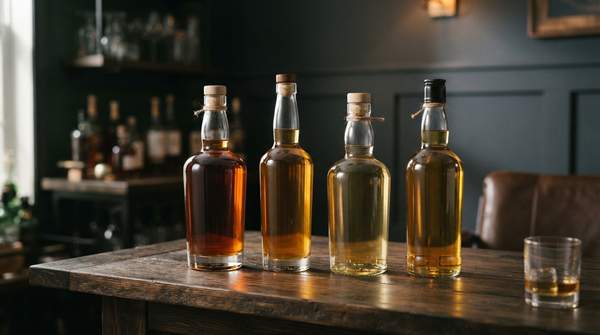
A versatile home bar does not require a crowded shelf. Four whiskey categories—Bourbon, Rye, Scotch, and Irish—cover nearly every sipping and mixing occasion, and each tastes the way it does because of what it is made from and how it is aged. Bourbon must be at least 51% corn, which gives it a sweeter, richer character; rye's 51% rye minimum produces its signature spice. Understanding those connections between grain, barrel, and flavor is the difference between buying bottles at random and building a deliberate collection.
Bourbon: The Sweet American Classic
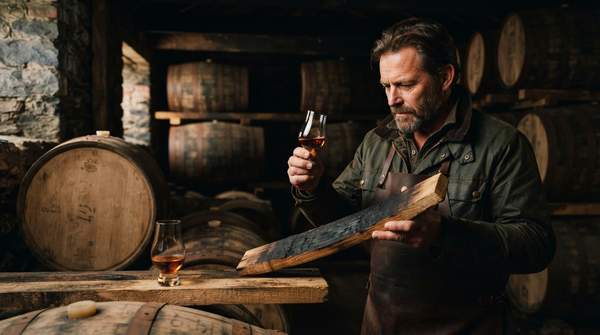
Bourbon is legally defined by its recipe and its barrel. The mash bill must be at least 51% corn, with the remainder typically made up of rye, wheat, and barley in proportions that vary by distiller. It must be aged in new, charred oak barrels—a rule that distinguishes it from corn whisky, which ages in used or uncharred oak, and from whiskey distilled from a bourbon mash but matured in used barrels, which cannot be called bourbon at all.
That high corn content is what makes bourbon taste the way it does: sweeter and richer than most other whiskeys, with the caramel and vanilla notes drawn from the charred new oak. Within the category, straight bourbon must be aged at least two years with no added flavoring or coloring, while bottled-in-bond expressions follow the 1897 act requiring one distillation season, one distillery, at least four years of age, and exactly 100 proof.
In practice, bourbon is the most flexible bottle on the bar. Its sweetness balances well in mixed drinks, making it a natural fit for an Old Fashioned or a Whiskey Sour, and a fuller-bodied expression rewards neat drinking. When tasting for a bar-cart feature, Jim Vorel of Paste Magazine noted that some bourbons carry "oak and spice complexity" while keeping their "fullness of body or corny sweetness," qualities that make them "a joy to drink neat" and equally at home in classic bourbon mixed drinks.
Rye Whiskey: The Spicy Cocktail Workhorse
Rye whiskey follows the same American rulebook as bourbon, with one decisive swap: the 51% minimum grain is rye instead of corn. That single change transforms the flavor. Where corn delivers sweetness, rye delivers spice—peppery, dry, and often described with notes of cinnamon, mint, and rye bread.
Rye's robust character is precisely what makes it the cocktail workhorse of the four. Its spice stands up to the other ingredients in complex, spirit-forward drinks, which is why it is the traditional choice for a Manhattan or a Sazerac, where a sweeter whiskey would flatten into the vermouth or sugar. Vorel's tasting notes on a rye-driven bottle capture the category's profile: "peppery spice and green apple fruitiness merge with orange peel, grain and earthy rye bread," with dried fruit, grass, and pepper lingering on the palate—a profile he concluded "begs to be mixed into any classic cocktail."
For a home bar, rye and bourbon are complementary rather than redundant. Bourbon brings the sweet, round base; rye brings the edge. A drinker who finds bourbon too sweet will often find rye's drier spice more satisfying, both in cocktails and sipped neat.
Scotch Whisky: Diverse and Complex
Scotch is made in Scotland under protected designation, and it is primarily built from malted barley, though some styles use blends of other grains. Single malts come exclusively from malted barley, while blended Scotch combines malt and grain whiskies into what CaskX describes as a harmonious blend. Unlike bourbon, Scotch matures in oak barrels that are often used—many of them previously held bourbon, which is why the same fresh-charred-barrel rule that defines bourbon cannot apply.
This is the category where generalizations break down, because Scotch's flavor range is the widest of the four. Depending on the bottle, it can run from fruity and delicate to intensely smoky, and the barley-and-used-barrel maturation is only part of the story; regional style and peat exposure drive enormous variation between expressions. That variability is a feature for the home bartender: a single versatile Scotch—often a blended or lightly peated one—can serve both as a contemplative neat pour and as the base for whiskey cocktails that call for its depth.
Because individual bottlings vary so much, treat any Scotch purchase as a specific decision rather than a category default. Read the label for region and style cues, and expect the bottle you select to define your Scotch experience more than the word "Scotch" itself does.
Essential Whiskeys for Your Home Bar: A Comparative Guide
The table below places the four categories side by side across the dimensions that actually drive flavor: the grain that dominates the mash bill, the barrel and aging rules, the resulting taste, and the role each plays best. The reasoning path is consistent for every row—grain and barrel determine flavor, and flavor determines use.
| Whiskey Type | Primary Grain(s) | Aging Process | Typical Flavor Profile | Best For |
|---|---|---|---|---|
| Bourbon | At least 51% corn; remainder typically rye, wheat, and barley (proportions vary) | New, charred oak barrels; straight bourbon aged at least two years | Sweet and rich, with caramel and vanilla notes from the corn and charred oak | Old Fashioneds, Whiskey Sours, other classic mixed drinks, or neat sipping |
| Rye Whiskey | At least 51% rye | Follows the same barrel rules as bourbon | Spicy, dry, and peppery, often with cinnamon, mint, and rye-bread notes | Manhattans, Sazeracs, and complex spirit-forward cocktails |
| Scotch Whisky | Primarily malted barley; blends combine malt and grain whiskies | Oak barrels, often used—many previously held bourbon | Variable, from fruity and delicate to smoky, depending on style and region | Sipping neat; a versatile bottle can anchor Scotch-based cocktails |
| Irish Whiskey | Frequently a mix of malted and unmalted barley | Maturation in bourbon and sherry casks in some expressions | Smooth and light, with vanilla, honey, and light spice in triple-distilled examples | Neat sipping or simple mixing; highly versatile |
Read across the rows and the pattern emerges: bourbon is generally sweet because corn dominates and the barrel is new and charred; rye is spicy because rye dominates; Irish is smooth, with Jameson's triple-distilled vanilla, honey, and light spice character making it, as one tasting guide puts it, incredibly versatile for neat sipping or mixing; and Scotch is variable because its styles diverge more than any other category's. Irish whiskey rounds out the set as the easy-drinking all-rounder—frequently built from a mix of malted and unmalted barley—and richer pot still expressions like Redbreast 12 Year add complex fruit, spice, and nut flavors developed through maturation in bourbon and sherry casks.
Confidently Stocking Your Home Bar
Select 3-4 distinct whiskey types—for example, Bourbon, Rye, Irish, and a versatile Scotch—based on their primary grain, flavor profile, and intended use for sipping or specific cocktails. A sensible starting quartet pairs a bourbon for sweet classics like the Old Fashioned, a rye for the Manhattan and Sazerac, a smooth Irish for easy neat pours and simple mixes, and one Scotch chosen deliberately for its regional style.
Two caveats keep expectations honest. This is a foundational guide to the main categories, not an exhaustive survey of sub-types or brands, and the tasting notes here are generalized for each category—individual bottlings will vary, so a specific bottle may taste different from its category's profile. Flavored whiskeys and liqueurs sit outside this framework entirely.
The measure of success is concrete: the reader successfully purchases a diverse set of whiskeys that cater to both neat enjoyment and cocktail mixing, reflecting an understanding of each type's unique characteristics. If your shelf lets you build an Old Fashioned, a Manhattan, and a contemplative neat pour without duplication of flavor, the collection is doing its job.
Sources
- What Is Bourbon? The Rules, the Mash Bill and the Barrel — Lonerider
- What's the Difference Between Whiskey and Bourbon? — Napa Valley Wine Academy
- Types of Whiskey: Bourbon, Scotch, Rye, and Irish Explained — The Mixologer
- The 10 Best Whiskeys for Your Bar Cart: Bourbon, Rye, Scotch and More — Paste Magazine
- Scotch, Bourbon, and Whiskey: Understanding the Distinctions - CaskX