The right outdoor knife is the one matched to what you actually do outside. If you split and process wood at camp, you need a tough, full-size fixed blade like the Ka-Bar John Ek Commando. If you carve tent stakes and slice food, a thin, slicy blade like the GiantMouse GMF-1 serves you better. If you count grams on an ultralight hike, a 1.2-ounce folder like the SOG Ultra XR is the whole point. Below, we compare these three representative knives and explain the design trade-offs behind them, so you can pick by activity rather than by brand.
Choosing Your Outdoor Companion: Understanding Knife Trade-offs
Every knife purchase is a set of compromises. Durability, cutting performance, and portability pull against each other, and the balance is set by three things: the steel, the size, and the overall design.
Reviewers who test survival knives tend to put durability first. The hands-on testers at Nothing But Knives, led by Andrew North, argue that "durability is probably king for survival knives," because a good one "can hold up to being your only tool in a lot of different situations"—cutting brush, breaking down wood, and cutting bandages. That logic fits a hard-use bushcraft knife, but it does not fit every trip. A knife built to survive abuse is heavier than one built to slice tomatoes, and a knife optimized for fine carving gives up some of that brute strength.
So the first question is not "which knife is best?" It is "what will I actually cut?" Once you answer that, the specifications start to mean something.
Outdoor Knife Comparison: Matching Blade to Bushcraft
The table below juxtaposes three very different knife profiles: a heavy-duty utility knife, a small versatile fixed blade, and an ultralight folder. Read it as a spectrum from hard-use capability on one end to portability on the other, with slicing efficiency as the third variable.
| Knife | Blade Steel | Blade Length | Weight | Primary Use Case | Key Trade-off |
|---|---|---|---|---|---|
| Ka-Bar John Ek Commando (Short Clip Point) | 1095 Cro-Van (high-carbon) | 5.125 in. | Heavy, though well balanced in the hand | Wood processing and tough camp tasks | Maximum durability and abuse tolerance over comfort and finesse |
| GiantMouse GMF-1 | Bohler N690 (stainless) | 2.625 in. | Very lightweight | Everyday carry and light camp tasks, including carving | Slicing and carving efficiency over heavy wood processing |
| SOG Ultra XR | Stainless steel (type not specified in the reviewed material) | 2.8 in. | 1.2 oz | Ultralight carry and light tasks | Minimal carry weight over hard-use capability |
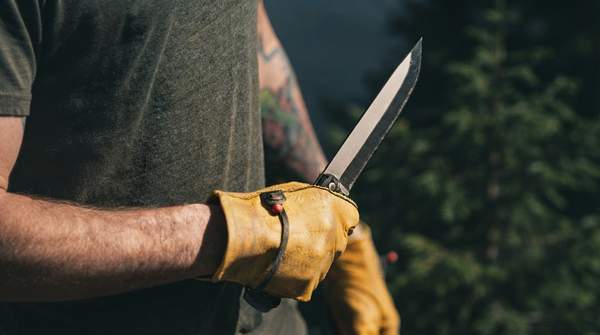
The comparison reveals the pattern. The Ka-Bar, at 9.25 inches overall with a 5.125-inch 1095 Cro-Van blade, is built for abuse. The GMF-1, designed by Danish knifemakers Jens Ansø and Jesper Voxnaes, is what Carryology's Piotr Ma calls "a true cutting machine"—high grinds, a relatively thin edge, and a fine tip make it the most slicy knife in his camp-knife roundup. The SOG Ultra XR collapses the whole question into weight: 1.2 ounces means you carry it everywhere, but you do not baton wood with it.
Blade Steel: Carbon vs. Stainless for Outdoor Durability
Steel choice is where most of the marketing noise lives, but the practical split is simple. The Ka-Bar's 1095 Cro-Van is a high-carbon steel. Carbon steels like 1095 are the traditional choice for hard-use knives because they take sharpening readily and tolerate impact, but they give up corrosion resistance: in wet outdoor environments, a carbon blade needs diligent care to keep rust at bay. That maintenance burden is the price of the toughness.
Stainless steels flip the trade. Writing at Knife Steel Nerds, metallurgist Larrin Thomas rates steels on toughness, edge retention, and corrosion resistance, and his long-term experience with N690 is telling: a knife he gave his granddaughter in N690 gets used often and, in his words, "she has yet to ask me to sharpen it." A steel comparison from Yashka Designs frames the same point more generally: N690 is "known for its balanced performance, good toughness, easy sharpening, and reliable everyday usability," while VG10 favors edge retention and corrosion resistance. Neither is simply better—the balance matters more than any single number.
Ma's camp-knife guide lands in the same place from the user's side: "When heat treated properly, Bohler's N690 Cobalt steel offers a good mix of edge retention, cutting performance, rust resistance, and… cost." For a knife that lives in a damp pack, that balance is why the GMF-1's stainless blade makes sense even though the Ka-Bar's carbon steel is the tougher choice for splitting wood.
Size and Weight: Matching Your Knife to the Task
Size is the most visible trade-off, and it is entirely contextual—it depends on your primary activities and the rest of your gear loadout. A 5.125-inch blade gives you leverage for batoning and chopping, but it is dead weight on a day hike where the hardest job is opening a sausage package. A 2.625-inch blade carves tent stakes and feathers wood beautifully, but it is out of its depth when a log needs splitting.
North's testing of the Ek Commando shows what a big knife buys you: it "handles all manner of wood processing tasks like a champ, and can take an enormous amount of abuse," and it carries well on the belt because it is so well balanced. But he is equally clear about the cost—"it's not the most comfortable knife"—and notes the handle scallops exist to keep an otherwise smooth grip secure. Comfort matters more than most buyers expect. BladeReviews puts it bluntly: "The handle of a survival knife is arguably more important than the blade," because an uncomfortable knife is used inefficiently and can even injure you.
Edge design deserves one note here too. The same reviewer prefers a plain edge over a serrated or partially serrated edge, reasoning that while serrations can "saw" through material after a plain edge goes dull, a maintained plain edge with a small field sharpener is more serviceable overall. All three knives in our comparison follow that plain-edge logic.
Making Your Choice: Practical Considerations
Now map the trade-offs to your calendar. If your trips involve processing firewood, building camp furniture, or working in conditions where the knife might be your only tool, the Ka-Bar John Ek Commando profile wins: carbon steel, five-plus inches of blade, and a design that absorbs abuse. Accept the weight and the rust-maintenance duty that comes with 1095.
If your outdoor knife is really a camp kitchen and carving tool—food prep, whittling, crafting wooden camp equipment—the GMF-1 profile is the better fit. Its thin, high-ground N690 blade is optimized for push-cuts and slicing, where "geometry and edge retention are everything," as Ma puts it. You give up the ability to split wood, which is fine if a saw or axe handles that job.
If your activity is measured in miles rather than tasks, the SOG Ultra XR profile—2.8 inches, 1.2 ounces—disappears into a pocket until needed. It will not replace a fixed blade for bushcraft, and it is not meant to.
Two honest limits on this guide: it covers three representative models, not an exhaustive survey, and it deliberately skips sharpening technique and the legal side of knife carry, which varies by jurisdiction and deserves its own research before you buy.
Selecting Your Ideal Outdoor Knife
Choose an outdoor knife by prioritizing either extreme durability, balanced versatility, or ultralight portability based on your most frequent outdoor activities. The decision rule is straightforward: pick the profile whose weakness you will never actually hit. A camper who never splits wood loses nothing with a slicy small blade; a bushcrafter who does loses everything with an ultralight folder.
The measurable indicator that you chose well is simple: the chosen knife's performance in its primary intended tasks—batoning wood, preparing food, or minimal carry—consistently meets expectations without compromising other essential gear or safety. If your knife fails that test on its first few trips, the trade-off you accepted was the wrong one, and the table above tells you which direction to move.