If you are a man who cannot comfortably touch his toes or sit cross-legged on the floor, a short daily stretching habit can help you move with more ease and reduce your risk of injury. Three foundational stretches cover the areas where men are typically tightest: the chest and shoulders, the hamstrings, and the hip flexors. Done correctly and held long enough, they form a routine you can complete in about five minutes.
Why Flexibility Matters for Men: Addressing Common Tightness
Men are often less flexible than women, a difference that PureGym attributes to hormones, connective tissue, bone structure, and lifestyle, with flexibility tending to decline further with age. That decline is not fixed: using your full range of motion and training flexibility consistently can prevent and reverse it. The practical case is straightforward, as the same guide notes benefits including a reduced risk of injury, less pain and stiffness, better posture, and improved gym performance.
The wider health literature backs the payoff. Harvard Health lists increased joint range of motion, enhanced circulation, reduced muscle stiffness and tension, better physical performance, and improved posture among stretching's benefits. UC Davis Health explains the injury rationale: tight muscles cannot extend fully, raising the risk of strains, pulls, and joint injuries. Two caveats apply: stretching is one component of injury-risk reduction, not a guarantee, and this is general fitness advice rather than a substitute for a doctor or physical therapist, particularly if you have existing injuries or conditions.
Essential Stretch 1: Doorway Chest Stretch
This movement targets the chest, the anterior deltoid at the front of the shoulder, and the biceps. Stand in the middle of an open doorway and place your forearms on each side of the frame; if the doorway is too wide, work one arm at a time. Gently lean forward until you feel a stretch through the front of your chest and shoulders. Healthline, whose instructions include this stretch in a five-minute daily routine, is explicit that you should only go as far as is comfortable, and hold for 30 seconds.
The stretch matters for men who sit at desks or train the pressing muscles heavily, because daily chest-opening work may help prevent tightness and promote better posture and breathing. The common mistake is leaning in too aggressively in pursuit of a deeper stretch. Breathe through the hold and let the position, not force, do the work.
Essential Stretch 2: Supine Hamstring Stretch
Lying on your back makes this hamstring stretch accessible and safe, because the floor supports your spine. Loop a towel around one foot and gently pull that leg toward your chest while keeping it straight. Keep the other leg flat on the floor, and avoid arching your back as the leg rises; if the back lifts or rounds, you are pulling too far. Hold for about 30 seconds, repeating three times per leg.
The stretch focuses on the muscles at the back of the thigh, a region where PureGym notes men commonly struggle — tight hamstrings are a frequent reason reaching the toes feels impossible. The guidance on intensity is consistent across sources: stretch to slight tension, never pain. If a towel is unavailable, a similar strap works; what matters is keeping the raised leg straight and the pelvis quiet so the hamstring, not the lower back, receives the stretch.
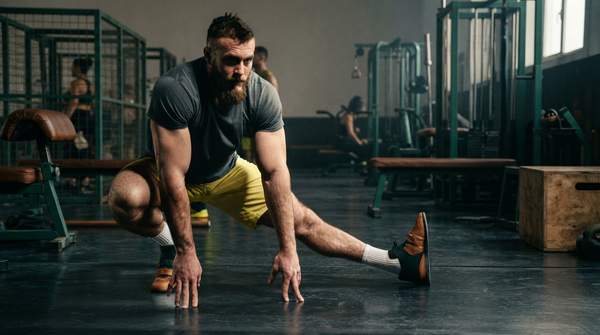
Essential Stretch 3: Kneeling Hip Flexor Stretch
The hip flexors, at the front of the hip, are a third chronic tight spot for men, and prolonged sitting only reinforces it. Kneel on one knee with the other foot planted forward, then gently push your hips forward until you feel the stretch at the front of the kneeling-side hip. Keep your back straight and engage your core so the movement comes from the hips rather than from arching the lower spine, which is the most common mistake in this position.
For hold time, the general guidance from PureGym applies: a stretch needs at least 20 seconds for muscles to begin to relax, and aiming for 30 to 60 seconds produces better results than a rushed five-second hold. Physical therapist Dr. Caitlin Cogan, writing for Highbar Physical Therapy, recommends an active approach to hip flexor work two to three times per week, noting that actively contracting the opposing muscles — the glutes and hamstrings — signals the hip flexors to release, and that a brief, gentle pull prevents the muscles from fighting back. You can apply that principle here by squeezing the glute of the kneeling-side leg as you lean forward.
Your Daily 5-Minute Flexibility Checklist
The table below distills the expert technique advice into verifiable actions and warnings. Check your form against each row as you perform the routine: the target tells you what you should feel, the key action tells you how to get there, the hold time tells you how long to stay, and the common mistake tells you what to correct.
| Stretch Name | Target Muscles | Key Action | Hold Time | Common Mistake |
|---|---|---|---|---|
| Doorway Chest Stretch | Chest and shoulders (including anterior deltoid) | Stand in a doorway, place forearms on the frame, and lean forward only as far as is comfortable | 30 seconds | Leaning in too far instead of stopping at a comfortable stretch |
| Supine Hamstring Stretch | Hamstrings (back of the thigh) | Lie on your back, loop a towel around one foot, and gently pull the straight leg toward your chest with the other leg flat on the floor | 30 seconds, 3 times per leg | Arching your back or stretching to the point of pain rather than slight tension |
| Kneeling Hip Flexor Stretch | Hip flexors (front of the hip) | Kneel on one knee with the other foot forward, and gently push your hips forward while engaging your core | 30–60 seconds | Arching the lower back instead of keeping it straight and moving from the hips |
Integrating Your 5-Minute Daily Flexibility Routine
Consistency, not intensity, is what produces results. PureGym identifies the most common mistakes as stretching with incorrect intensity, not being consistent, and not holding long enough — and recommends stretching each muscle group at least twice per week as a minimum. Mayo Clinic adds the practical safety foundation: warm up with five to ten minutes of light activity before stretching, keep stretches gentle and slow, never bounce, and breathe through each hold.
Timing the routine to an existing anchor makes it stick: after a shower, before your commute, or at the end of the workday. Stretching after a workout, when muscles are warm, is usually best. A pliability routine guide for men suggests holding each static stretch 30 to 60 seconds per side, breathing slowly throughout, and treating sharp pain as a stop signal while accepting mild discomfort as normal.
Commit to Daily Flexibility for Lasting Benefits
Integrate a 5-minute daily stretching routine into your schedule to improve flexibility, increase range of motion, and reduce muscle stiffness. That is the decision, and the routine above makes it concrete: one doorway stretch, one floor-based hamstring stretch, and one kneeling hip flexor stretch, held properly and without force.
You will know it is working by the measurable indicator of reduced sensation of tightness in common areas like the chest, hamstrings, and hips, and improved ease of movement in daily activities — reaching your toes, sitting on the floor, or moving through a full workday with less stiffness. Harvard Health's framing captures the payoff: for the avid exerciser and the desk-bound alike, making time to stretch can be transformative.
Sources
- Flexibility Exercises For Men — Puregym
- The ideal stretching routine - Harvard Health
- How to improve your stretching and flexibility for better health — cultivating-health
- A Daily 5-Minute Stretching Routine That Everyone Needs — Healthline
- 8 Of The Best Stretches for Tight Hip Flexors Recommended by Physical Therapists — Highbar - Physical Therapy
- stretching routine for men: 20 full-body stretches — Pliability