
Growth changes what a business needs from its payment system.
A small business may initially need little more than a countertop card terminal. As transaction volume increases, employees multiply, locations expand, and customers expect more payment options, the original setup can begin to feel limiting. At that point, upgrading the payment infrastructure becomes less about buying new equipment and more about creating a system that can support the way the business operates.
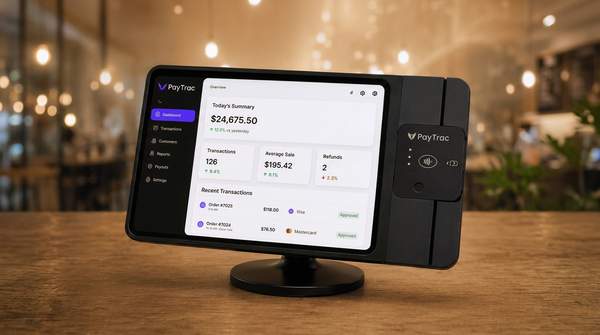
PayTrac provides POS and payment processing solutions designed for businesses ranging from individual operations to high-volume and multi-location organizations. Its offerings include POS systems, countertop solutions, mobile payment technology, traditional pricing, cash discounting, and surcharging.
Why POS Technology Matters
A point-of-sale system is often one of the most frequently used technologies inside a business.
Employees rely on it to complete transactions. Customers interact with it at checkout. Managers may depend on transaction information for reporting and reconciliation.
When the system is slow, difficult to use, or poorly matched to the business, the effects can extend beyond payment acceptance.
A better POS setup should fit the business's workflow.
A restaurant may need pay-at-the-table functionality. A retailer may prioritize fast countertop transactions and contactless acceptance. A service business may need mobile payment capabilities. A company operating across several locations may need consistent technology and reporting.
PayTrac's solution categories include POS systems, countertop solutions, and mobile solutions, allowing merchants to consider different payment environments rather than relying on a single equipment format.
Start With the Business Workflow
Before choosing a POS system, businesses should examine how customers actually pay.
Where does the transaction take place?
How many employees accept payments?
Are customers waiting in line?
Do employees need to move around the premises?
Does the business operate from multiple locations?
Are online, mobile, or in-person payments all part of the customer journey?
The answers can help determine which equipment and payment capabilities are most useful.
PayTrac supports countertop and wireless terminals, mobile payment options, and pay-at-the-table capabilities. Its site also references EMV- and EBT-ready equipment and support for major contactless payment methods.
These options can be especially relevant for businesses where payment acceptance does not happen in one fixed location.
Payment Processing and POS Should Work Together
A POS system can be impressive on its own, but payment processing still needs to work smoothly behind the scenes.
Businesses should therefore consider the POS and merchant account together.
PayTrac's offering combines payment processing with POS and related payment technology. Merchants can also choose between different pricing approaches, including traditional pricing, cash discounting, and surcharging.
This integrated approach can simplify the evaluation process.
Instead of selecting equipment from one provider and payment processing from another without considering how the systems interact, merchants can evaluate the payment environment as a complete operation.
Mobile Payments Create More Flexibility
Not every transaction needs to happen at a traditional register.
Mobile payment technology can be useful for service businesses, events, restaurants, field operations, and other environments where employees need to accept payment away from a fixed counter.
PayTrac includes mobile solutions within its payment technology offering and also references wireless terminals.
The benefit is flexibility.
Employees can meet customers where the transaction naturally occurs instead of forcing every payment through a single checkout point.
That can help businesses create a more convenient customer experience while giving employees the tools they need to complete transactions efficiently.
Supporting Faster Customer Checkouts
Checkout speed matters.
A slow payment process can create lines, interrupt employee workflow, and frustrate customers. In high-volume environments, even small delays can become more noticeable over the course of a busy day.
Payment equipment should therefore be evaluated for reliability, usability, and the types of transactions a business processes most often.
PayTrac promotes payment technology designed for different environments, including countertop, mobile, wireless, and pay-at-the-table solutions.
The right combination depends on the business.
A restaurant may benefit from payment at the table. A retail store may prioritize fast countertop transactions. An automotive shop may need flexible payment acceptance around a service operation.
Reporting Matters as Businesses Grow
Payment processing generates operational data that businesses can use to understand transaction activity.
PayTrac's traditional pricing solution includes access to a custom merchant portal with real-time transaction data, reports, and account insights.
This visibility can become increasingly useful as a business grows.
Managers may need to reconcile transactions, monitor payment activity, review reports, or understand how different locations are performing.
Centralized access to payment information can make these tasks easier to manage.
Choosing the Right Pricing Structure
A POS system is only one part of the payment equation.
Businesses should also examine how they want to handle processing costs.
PayTrac offers traditional pricing for merchants seeking a conventional processing structure. Its cash discounting program allows qualifying businesses to offer a discount to cash-paying customers, while its surcharge program provides another method for addressing eligible credit-card processing expenses.
These options give businesses an opportunity to evaluate payment pricing alongside technology.
The decision should be based on transaction volume, customer preferences, applicable requirements, and the merchant's broader operating model.
Industry-Specific Needs Can Change the Equation
Different industries often require different payment workflows.
PayTrac has dedicated payment solutions for healthcare and automotive businesses.
Its healthcare offering focuses on EHR and EMR integrations, in-office, online, and mobile payments, and a surcharge program intended for healthcare providers. The company identifies integration relationships involving platforms such as athenahealth, Epic, Meditech, eClinicalWorks, NextGen, and Oracle Health.
Its automotive solution is designed for independent auto and tire shops as well as larger automotive operations. PayTrac highlights dealership-management-system integrations, faster checkout, mobile and online payment options, and cash discounting.
These examples demonstrate why businesses should evaluate payment technology in the context of their industry rather than choosing equipment based solely on general features.
Building a Payment System That Can Grow
A payment system should not only solve today's problems.
It should also leave room for tomorrow's requirements.
A business may add another location, introduce mobile payments, increase transaction volume, expand its POS capabilities, or change the way it approaches processing costs.
PayTrac's focus on high-volume merchants, franchises, and multi-location organizations reflects this need for scalable payment infrastructure.
For business owners, the evaluation process should therefore consider both immediate requirements and anticipated growth.
The objective is to select a payment environment that employees can use, customers can navigate, and managers can monitor.
Explore Your POS and Payment Options
The right POS system can become an important part of a business's daily operations.
PayTrac brings POS technology, payment processing, pricing options, merchant reporting, and specialized industry solutions together under one provider. That gives businesses a practical starting point for reviewing their existing payment infrastructure and identifying areas for improvement.
Whether a business needs a countertop terminal, mobile payment capabilities, pay-at-the-table technology, or a broader multi-location payment strategy, the right solution starts with understanding how the business actually operates.
For merchants ready to review their current setup, PayTrac can help explore payment processing and POS options designed around the business's transaction environment and growth plans.


