The best travel adapter isn't a single product—it's the right category for your devices. If you charge only a phone and small gadgets, a compact universal block like the Anker Nano, with its 20W USB-C output, will do the job and vanish into a pocket. If you travel with a laptop, you need a high-power universal adapter delivering 65W or more over USB-C Power Delivery. And if your priority is versatility across specific regions rather than one do-everything brick, a multi-piece kit earns its place in your bag. Here is how to work out which one is yours.
Understanding Travel Adapter Types: A Decision Framework
Every adapter on the market squeezes into one of three shapes, and the differences between them are more consequential than brand names suggest. Wirecutter's travel writers, reviewing the category, landed on exactly this split: a compact universal top pick (the Anker Nano), a higher-power upgrade pick (the Epicka TA-105 Max), and a set of individual plugs (the Ceptics International Travel Adapter Plug Set). The trade-offs run along two axes: how much power the adapter can push to your devices, and how much space it demands in return.
One universal truth binds all three categories: none of them changes voltage. A travel adapter changes the plug shape so it fits foreign outlets, as one reviewer puts it plainly. If your appliance is single-voltage—a 110V-only hair dryer, say—an adapter alone will damage it or blow a fuse in a 220V outlet. Dual-voltage devices, labeled 100–240V, are safe. Voltage converters are a separate product for a separate problem, and outside this guide's scope.
Compact Universal Adapters: Portability for Phones and Small Devices
The Anker Nano is the category's exemplar, and Wirecutter calls it the smallest universal adapter its team tested, with two USB-C and two USB-A outputs. Anker's own specifications confirm the charging math: USB-C1 delivers up to 20W, USB-C2 tops out at 15W, and when ports share, the total USB output drops to 15W. USB-A ports are limited to 12W. That is phone-and-tablet territory—fine for overnight top-ups, insufficient for most laptops.
The compactness buys you real convenience. One minimalist-travel reviewer notes the Nano is half the size of larger universal adapters and cheaper, making it the obvious choice when you're only charging a phone and small items. The trade-off is structural: it's a two-prong, ungrounded design, so you're limited to devices with ungrounded plugs. Anker frames this as a safety feature, since travel adapters typically lack a grounded connection, and Wirecutter judged it acceptable because most travel-friendly devices use two-prong plugs anyway.
High-Power Universal Adapters: Charging Laptops and Multiple Devices
When a laptop enters your luggage, the wattage requirement climbs, and that's where high-power universal adapters justify their extra bulk. Wirecutter's upgrade pick, the Epicka TA-105 Max, is built for exactly this: Pack Hacker's review of a comparable adapter notes that 65W from a USB-C port is enough to charge a laptop, though some devices might need more. The Epicka's USB-C ports support Power Delivery, with up to 20W each and a 55W ceiling when charging across all ports simultaneously, according to WIRED's testing.
The ceiling keeps rising for travelers with heavier loads. Pack Hacker describes a specialized option that can theoretically charge nine devices at once, with 205W available when only a few are connected—though power divides across ports and speeds drop as you add devices. The reviewer's verdict is sensible: solo travelers with a phone and laptop don't need six USB-C ports, but families or anyone hauling cameras, tablets, and laptops could get real use from the connectivity.
One cable caveat from the minimalist-travel review deserves attention: a basic USB-C cable tops out at 60W, so for more than that you need one rated for 100W, or 240W for the full 140W. The adapter's wattage is only half the equation.
Multi-Piece Adapter Kits: Versatility for Specific Regions
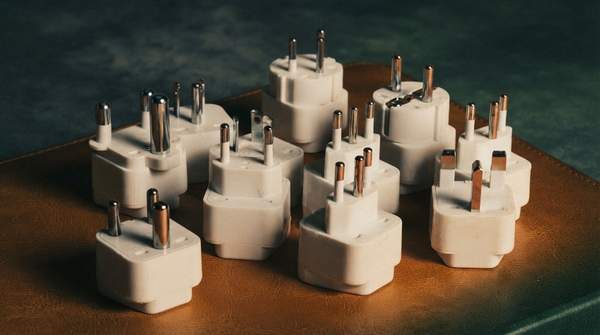
The third category abandons the single universal block for a set of individual plug adapters, often bundled with a pouch. Wirecutter's top set is the Ceptics five-piece plug set, with a 12-piece version for more destinations. The appeal is simplicity: each piece is a dumb, reliable plug-shape converter with no electronics to fail, and you carry only the ones your itinerary requires.
The counterargument is bulk. The minimalist-travel reviewer, who travels with only a wheeled carry-on backpack, argues that a whole set means unwanted volume compared to a single universal solution, and criticizes sites that recommend expensive, bulky adapter sets. On the other side, Whimsy Soul's frequent-flyer reviewer picks the TESSAN All European UK kit at 4.07 ounces as her choice. Kits also suit travelers who know their destinations and prefer dedicated plugs over a sliding, multi-pronged mechanism. Your packing style, more than any spec sheet, decides this one.
Essential Safety Features: Fuses vs. Surge Protection
Two safety mechanisms get conflated in product listings, and the distinction matters. A fuse—whether replaceable or auto-resetting—protects against overcurrent. The Anker Nano uses an auto-resetting fuse: if a power surge trips it, or you plug in something exceeding its rating, it resets itself after 10 seconds, as Wirecutter describes. Other adapters, like the Ceptics universal unit, use a replaceable fuse with a spare in the box, so a blowout on the road doesn't end your trip.
Surge protection is different: it guards against voltage spikes that can damage sensitive electronics, and not every adapter has it. The Nano carries 300J of surge protection, per Anker's specifications. But several well-regarded adapters don't: WIRED's tested Type G model "does not offer surge protection," and Whimsy Soul's TESSAN pick likewise lacks it—though that absence is precisely what makes it cruise-ship approved, since cruise lines often prohibit surge-protected devices. If you're plugging in an expensive laptop, surge protection is worth prioritizing; for a cheap phone charger, a fuse may be enough.
Decision Framework: Choosing Your Travel Adapter Type
Map your devices and priorities onto the matrix below. The logic is straightforward: your power requirement rules out categories first, then your portability preference picks among the survivors.
| Your profile | Best-fit category | Example and key specs | Trade-off you accept |
|---|---|---|---|
| Phone and small devices only; smallest possible kit | Compact universal | Anker Nano: 20W USB-C max (15W shared), auto-resetting fuse, 300J surge protection, two-prong only | Not enough wattage for most laptops; ungrounded plugs only |
| Laptop plus phone; work trips | High-power universal | Epicka TA-105 Max: USB-C PD, 20W per port, 55W total across ports; comparable adapters reach 65W | More bulk and cost than a compact block |
| Many devices, family travel | High-power universal (specialized) | High-capacity models with up to 205W and many ports | Largest size; speeds drop when all ports are used |
| Known destinations; minimal electronics; cruise travel | Multi-piece kit | Ceptics plug set (5 or 12 pieces); TESSAN kit at 4.07 oz | Carrying multiple pieces; typically no USB ports or surge protection |
Read the table as a sequence of questions. First: does a laptop travel with you? If no, compact wins on size and price. If yes, you need USB-C PD wattage in the 65W range, which means a high-power universal. Second: do you value dedicated regional plugs or cruise-ship compliance over a single block? Then a kit fits, accepting that you'll carry multiple pieces and usually forgo built-in USB charging.
Your Next Step: Selecting the Right Adapter for Your Journey
Choose a travel adapter type—compact universal, high-power universal, or multi-piece kit—that aligns with your primary devices' power requirements and your travel style's emphasis on portability or versatility, and confirm it carries the safety features your electronics deserve: at minimum a fuse, and surge protection if a laptop is involved. Check that your USB-C cable is rated for the wattage you intend to draw.
You'll know you've chosen well when you can state, before buying, the USB-C PD wattage your devices need and whether your itinerary demands surge protection or a fuse alone. If you can answer both questions from this framework, the right adapter category—and the right model within it—will be obvious on the product page.
Sources
- These Are the Plug Adapters Our Travel Writers Depend on to Stay Powered Up — Wirecutter: Reviews for the Real World
- Anker Nano Travel Adapter (5-in-1, 20W, 1-Pack)
- Anker Nano 5-in-1 Travel Adapter International Travel Charger A9215 — ---
- The Best Universal Travel Adapter: My Fast-Charging Pick, Plus the Smallest Ones – Minimalist.Travel
- Best Travel Adapter for International Travel – Pack Hacker — Packhacker
- A Bad Travel Adapter Could Ruin Your Vacation. Buy One of These Instead — WIRED
- 8 Best Travel Adapters for International Travel (Tested by a Frequent Flyer) — Whimsy Soul
- Anker — Service