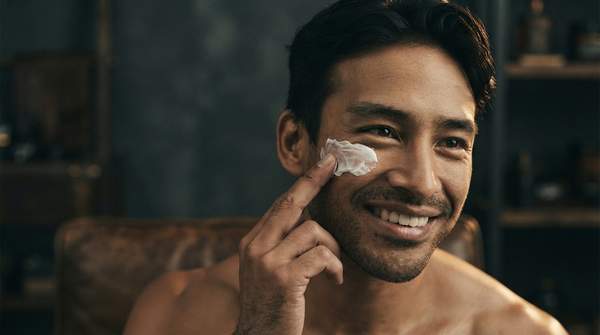
Antioxidants matter more for men's skin than most men realize, and the most effective products do not rely on a single hero ingredient. The strongest environmental protection comes from a combination of Vitamin C, Vitamin E, and Ferulic Acid, which stabilize one another and defend against different aspects of oxidative damage. Understanding how that trio works together makes it far easier to judge a product label than any marketing claim can.
Understanding Environmental Damage and Men's Skin Vulnerability
Environmental stressors such as ultraviolet radiation generate free radicals: unstable molecules that damage skin cells, break down supportive structures, and accelerate visible aging. Antioxidants counteract this process by neutralizing free radicals before they can do harm. Skin has natural antioxidant defenses, but they are finite and can be overwhelmed by chronic exposure.
Men's skin carries a particular vulnerability. A pilot study published in the Journal of Cosmetic Dermatology, evaluating a topical antioxidant developed specifically for men, notes that male skin is more vulnerable to environmental insults and particularly to UV exposure, contributing to skin damage and accelerated skin aging. The same paper cites National Health Interview Survey data covering more than 31,150 adults, in which only 22.1% of men regularly used sunscreen with SPF 15 or higher, compared with 40.2% of women.
A study of nearly 2,450 adult outdoor runners found a similar gap: only 17% of men reported adequate sun-protective behaviors versus 33% of women. In other words, men face greater exposure-driven risk while practicing less protection, which makes topical antioxidants a meaningful addition to a routine.
Vitamin C: A Potent Brightener and Protector
Vitamin C (L-ascorbic acid) is a water-soluble antioxidant and one of skin's essential defenders. Dermatologists Neera Nathan and Payal Patel, writing for Harvard Health, report that Vitamin C may help protect skin from harmful ultraviolet rays when used alongside broad-spectrum sunscreen, and that clinical studies combining Vitamin C with ferulic acid and Vitamin E showed reduced redness and protection from long-term sun-induced damage.
Vitamin C also affects pigmentation. It can reduce the appearance of dark spots by blocking pigment production in the skin; in clinical trials, most participants applying topical Vitamin C saw improvement in dark spots with little irritation, though Harvard Health notes more studies are needed to confirm the brightening effect.
The ingredient has one well-known weakness: on its own, Vitamin C oxidizes rapidly, which reduces its potency. This instability is precisely why formulation matters, and it explains why Vitamin C rarely performs best alone.
Vitamin E: The Skin's Moisturizing Shield
Vitamin E (tocopherol) works differently from Vitamin C because it is lipid-soluble. That property lets it operate in the fatty environment of cell membranes, protecting them from oxidative stress. The skin-care formulation resource Let's Make Beauty describes this membrane-level role and its consequence: Vitamin E is itself susceptible to oxidation, which diminishes its protective ability once it has absorbed free radicals.
Cleveland Clinic notes that Vitamin E also supports the skin's moisture barrier, and that moisturizers containing as little as 0.1% Vitamin E can improve Vitamin E levels in the skin. The clinic's guidance is direct on the central point of this article: products that include both Vitamin C and E are preferable, because "these antioxidants work better together."
Ferulic Acid: The Antidant Enhancer
Ferulic Acid is the least familiar member of the trio, but it may be the most important to the combination. It is a hydroxycinnamic acid with a phenolic structure, found naturally in the cell walls of grains, fruits, and vegetables, including rice bran, wheat and oat bran, apples, oranges, eggplants, and coffee beans. Plants use it to protect themselves from UV radiation and oxidative stress, and it plays a similar shielding role in skin.
According to Let's Make Beauty, Ferulic Acid's crucial contribution is enhancing the stability and effectiveness of Vitamins C and E, while also boosting UV defense when paired with other actives. Without it, the other two antioxidants degrade faster; with it, the entire formulation holds its protective capacity longer.
The Power of Synergy: Why Combinations Excel
The individual ingredients are good; the combination is what makes them exceptional. The Linus Pauling Institute at Oregon State University catalogs the underlying research, including a study on UV photoprotection by combined topical Vitamin C and Vitamin E, and a separate study on the protective effects of a topical mixture containing Vitamin C, ferulic acid, and phloretin against UV-induced photodamage in human skin.
Additional support comes from an in vivo study of 15 healthy adults, cited in a skin-health review of Vitamin C, which found protective effects from Vitamin C mixtures, including a Vitamin C, Vitamin E, and ferulic acid combination, against ozone exposure on the forearms. The same review references a study in which sunscreen plus antioxidants protected skin against an increase in MMP-1, an enzyme associated with matrix breakdown, where sunscreen alone did not.
The mechanism is complementary coverage: Vitamin C works in the water-based compartments of skin, Vitamin E in the lipid-based membranes, and Ferulic Acid stabilizes both while adding its own free-radical scavenging. Each ingredient covers the vulnerability of the others.
Antioxidant Synergy: The Gold Standard Trio
The table below compares the three ingredients by their primary function, key benefit, and most effective pairing. Read across each row, then compare the final column: the pattern is that each ingredient's best partner is the other two, which is why the combined trio outperforms any single ingredient.
| Ingredient | Primary Function | Key Benefit | Works Best With |
|---|---|---|---|
| Vitamin C (L-ascorbic acid) | Water-soluble antioxidant; helps block pigment production | Diminishes redness, brightens dark spots, and helps protect against long-term sun damage; unstable on its own | Vitamin E and Ferulic Acid, which enhance its protection and stability |
| Vitamin E (tocopherol) | Lipid-soluble antioxidant protecting cell membranes | Supports the moisture barrier; depletes through oxidation unless stabilized | Vitamin C, which regenerates its antioxidant capacity and provides UV photoprotection together |
| Ferulic Acid | Plant-derived antioxidant from cell walls; scavenges free radicals | Less widely recognized, but stabilizes the other two and boosts UV defense | Vitamins C and E, where its stabilizing role makes the whole formula more effective |
That final column is the evidence-derived conclusion of the comparison: every ingredient's optimal pairing points back to the same trio, because Ferulic Acid's stabilizing effect plus the complementary water- and lipid-phase actions of Vitamins C and E create broad-spectrum protection no single ingredient provides alone.
Identifying Effective Antioxidant Combinations in Skincare
Translating the science into shopping practice is straightforward. Look at the ingredient list, not the front of the bottle. A well-formulated antioxidant serum will name a Vitamin C form such as L-ascorbic acid, a Vitamin E form such as tocopherol, and ferulic acid among its ingredients. Harvard Health's clinical evidence for reduced redness and long-term sun protection specifically involved combinations of Vitamin C with ferulic acid and Vitamin E, not Vitamin C alone.
Layering matters less than the presence of the combination itself. And no antioxidant replaces sunscreen: the MMP-1 finding above compared antioxidant-containing sunscreen against sunscreen alone, and Harvard Health frames Vitamin C as an addition to, not a substitute for, broad-spectrum sun protection. Note two boundaries for this article: it covers only these three ingredients, not the full landscape of antioxidants, and it is informational, not medical advice. A dermatologist can tailor recommendations to individual skin concerns.
Actionable Skincare: Choosing Your Antioxidant Defense
Men should prioritize skincare products that combine Vitamin C, Vitamin E, and Ferulic Acid to leverage their synergistic protective effects against environmental damage. Given men's documented higher UV vulnerability and lower rates of sun protection, this combination addresses a real gap rather than a marketing preference.
The measurable indicator is simple and immediately checkable: look for product labels explicitly listing Vitamin C (for example, L-ascorbic acid), Vitamin E (for example, tocopherol), and Ferulic Acid among the active ingredients. If all three appear together, the label describes a formulation matching the combination shown in clinical studies to protect against UV- and ozone-induced damage; if one is missing, the product forfeits part of the synergy that makes the trio the gold standard.
Sources
- A pilot study evaluating the efficacy and tolerability of a comprehensive, hydrating… — PMC
- Why is topical vitamin C important for skin health? - Harvard Health
- Synergistic Antioxidants: How Ferulic Acid Boosts the Efficacy of Vitamin C & E — Letsmakebeauty
- What Vitamin E Does for Your Skin's Health — Cleveland Clinic
- Vitamin C and Skin Health — Linus Pauling Institute
- The Roles of Vitamin C in Skin Health - PMC