Consistent grilling comes down to two skills: controlling how hot your grill runs, and choosing whether food sits over the fire or beside it. On a charcoal grill, temperature is governed by airflow through the dampers, not by how much charcoal you load. On a gas grill, it is governed by which burners you switch on. Master both, and you can sear a steak or slow-cook a whole chicken on the same piece of equipment with predictable results.
Direct vs. Indirect Heat: The Core Decision
Direct grilling means placing food directly over the heat source, which Char-Griller likens to searing a ribeye right over the coals. It behaves much like cooking in a skillet on a stove: the grate itself transfers heat straight into the food. Direct heat is the tool for fast cooks, hard sears, and the char many cooks want.
Indirect grilling places food near, but not directly over, the fire. Writing for Salt Pepper Skillet, Justin McChesney-Wachs describes this as a "cool zone" that is still hot, but far cooler than the direct flame; with the lid closed, hot air circulates and the grill works like an oven. Char-Griller notes that indirect cooking can mean the coal-free side of a two-zone fire, a warming rack, or an offset setup. This is the method for cooking food through without burning the outside, and, per Susie Bulloch of Hey Grill, Hey, it gives you somewhere to move food when flare-ups demand it.
Charcoal Grill Mastery: Harnessing Dampers for Precision
The single most useful fact about charcoal temperature control is that dampers matter more than charcoal quantity. Sean Mathy, writing for Weber, puts it plainly: "The more air going into the grill, the hotter the grill will get. The less air going into your grill, the cooler it will get." Char-Griller echoes the same rule—open the dampers for more airflow and heat, close them to cool the grill down.
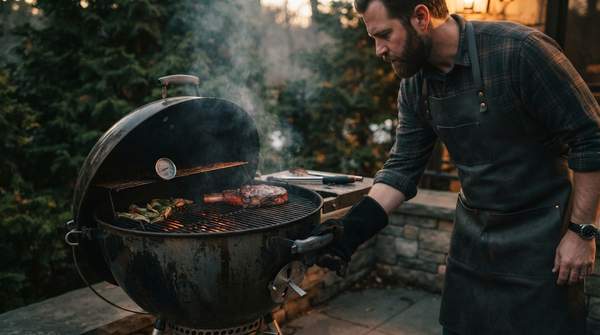
Most Weber charcoal grills have two sets: a top lid damper and dampers on the bottom bowl. Mathy recommends leaving the bottom dampers fully open and using the top lid damper as your throttle. That gives you one adjustment point rather than two competing ones. To create zones, pile lit coals to one side rather than spreading them evenly: the pile side becomes your direct zone, and the empty side becomes indirect.
Gas Grill Zones: Setting Up for Success
Two-zone cooking on a gas grill is a burner-management exercise. Bulloch's guidance is that it works with any number of burners: turn on half the burners on the same side to provide hot, direct heat, and leave the other half off so that side generates little to no heat. Preheat with the lid closed and let the grill come to temperature before cooking.
The exact configuration depends on how many burners your grill has, so think in halves rather than in specific burner numbers. If a recipe calls for two-zone grilling, it is usually because at least one stage of the cook needs gentle, indirect heat, as cookbook author Jess Pryles explains in her setup guide. The payoff, Bulloch adds, is flare-up insurance: when fat hits the flame, you can pull food to the cool side instead of fighting the fire.
Grilling Heat Decision Framework
The table below classifies common foods by how quickly they cook through versus how deeply they need heat to penetrate, then recommends the heat application for each category. Use it to plan your grill setup before you light it.
| Method | How it works | Best for | Example foods |
|---|---|---|---|
| Direct heat | Food sits directly over the flame or coals; fast, intense cooking similar to a skillet | Quick-cooking foods that need a sear or crust | Steaks (grill at 450–600°F per Monument Grills), boneless chicken breasts (425–450°F, medium-high, direct) |
| Indirect heat | Food cooks beside, not over, the heat source with the lid closed, acting like an oven | Foods needing longer cooking at lower temperatures without burning; fatty cuts prone to flare-ups | Brisket and pork shoulder (225–250°F), whole chicken and roasts (325–350°F, lid closed) |
| Combination | Sear over direct heat, then move to the indirect zone to finish cooking through | Thicker items that need both a crust and thorough interior doneness | Thick steaks and bone-in chicken pieces—sear, then finish on the coal-free or burner-off side |
Monument Grills' temperature guidance, which pairs grill temperature with heat setup and finished internal temperature, supplies the ranges above—treat them as guidelines, since ambient weather and your specific grill model will shift real temperatures. Chicken thighs, for example, are listed at 375–450°F medium-to-medium-high heat, safe at 165°F but often cooked to 175°F or higher for more tender dark meat.
Achieving Perfect Doneness: Your Grilling Success Signal
Mastering grill temperature control and the strategic use of direct and indirect heat zones is essential for consistently cooking food to the desired doneness. The framework is simple: decide before you light the grill whether tonight's meal needs direct heat, indirect heat, or a sear-then-move combination, then build that zone—coals piled to one side with the lid damper as your throttle, or half the burners on and half off.
You know the system is working when food consistently reaches the target internal temperature without burning the exterior, and your grill holds its desired temperature range through damper or burner adjustments rather than luck. This guide covers gas and charcoal principles only—pellet grills and smokers operate differently—and covers setup rather than recipes. Watch the thermometer, make small damper or burner moves rather than large ones, and let the zones do the work.
Sources
- How To Control Heat & Temperature — Char-Griller
- Two Zone Grilling Setup and How to Use It — Salt Pepper Skillet
- How to Cook with Two-Zone Grilling - Hey Grill, Hey
- How to Control the Temperature of Your Charcoal Grill — Weber.com
- How to set up a grill for two-zone cooking – Jess Pryles
- 6 Grill Temperature Tips: 225°F Low to 600°F Searing — Monument Grills