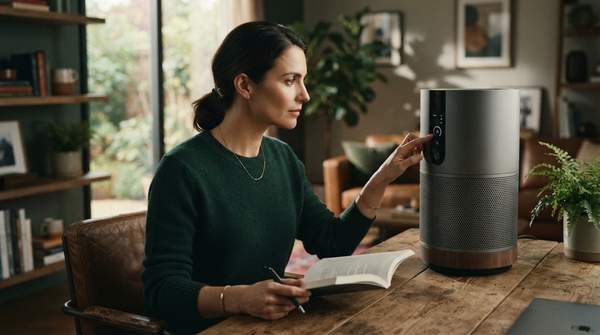
The right portable air purifier is the one whose clean air delivery rate (CADR) matches your room and whose filter type matches your pollutant problem. CADR, measured at the machine's highest speed, tells you how many particles a unit removes and how large an area it can serve, according to the US Environmental Protection Agency. If your concern is smoke, you need a high smoke CADR; if it's pollen, a high pollen CADR. Pair that number with a HEPA filter for particles and an activated carbon filter for gases and odors, and check the AHAM Verified seal before trusting any room-size claim.
Understanding Your Indoor Air Quality Concerns
Start by naming your problem, because the EPA organizes air purifier ratings around three example pollutants that stand in for particle size categories: tobacco smoke represents small particles, dust represents medium particles, and pollen represents large particles. Small particles include those of greatest health concern, such as PM2.5, which the EPA identifies as the fine fraction most air cleaners and furnace filters can address. Medium-sized dust is the everyday household variety, while pollen is the classic seasonal large particle that troubles allergy sufferers.
This size framing matters because a purifier that excels at one particle size may not be the best choice for another. Consumer Reports makes the same point from the shopping side: there are separate CADR ratings for removing tobacco smoke, dust, and pollen, and you should focus on the rating for your main pollutant of concern. Gases and volatile organic compounds sit outside this particle framework entirely, which is why filter type—not just the CADR number—becomes the second half of your decision. One limitation: the evidence categorizes these three examples by size, but does not assign a size class to dust mites or pet dander, so this framework should not be extended to those allergens without further research.