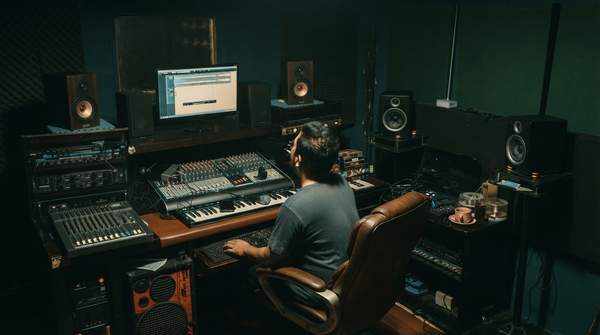
Film sound rests on three pillars: dialogue, which carries the story; sound effects and foley, which build the physical world; and music, which steers emotion. Each does a distinct job, and learning to hear them separately is the first step toward understanding why a scene feels tense, tender, or terrifying. This guide explains what each pillar does and how filmmakers weave them together, including the deliberate use of silence.
The Unseen Power of Film Sound
Cinema is the only major art form that combines sight and sound into a single unified experience, as the filmmaking resource StudioBinder puts it: striking visuals "don't hold the same weight without strong cinematic sound design to back them up." Sound is not an accessory bolted onto the picture. It is every kind of audio a filmmaker deploys to set tone, evoke emotion, and enhance the audience's mood, as the film school APAC describes it—a mixture of effects, foley, music, dialogue, and mixing.
What makes sound so powerful is its invisibility. Layered beneath the image, it adds depth, texture, and emotion to scenes that would otherwise feel flat. Filmmakers also use sound to convey off-screen information, build anticipation, or spring a surprise—things the camera alone cannot do. A sound can place an object or character beyond the frame entirely, letting the audience sense a world larger than what is visible.
Dialogue: The Voice of the Story
Dialogue is the most direct channel between the film and its audience. A 2025 narrative literature review in the Journal of Cultural Analysis and Social Change examined how dialogue functions as a core narrative strategy in contemporary drama, mapping its roles into three layers: diegetic (exposition and clarity), pragmatic (speech acts, subtext, conflict), and affective (rhythm, tension, immersion).
In practice, that means dialogue does far more than deliver information. It reveals character, carries subtext and indirect meaning, and drives conflict and persuasion. It sets the rhythm of a scene—quick, clipped exchanges accelerate pace; long pauses slow it down. Dialogue can establish realism or land a joke, and it works in combination with silence, picture, and camera movement to control the emotional pace of a story. When you watch a film, dialogue is usually the element doing the narrative heavy lifting: telling you who these people are and what they want.
Sound Effects and Foley: Bringing Worlds to Life
Sound effects are the auditory elements that create specific moods, atmosphere, and realism. Foley deserves special mention: it is the craft of creating and recording sounds in sync with the visual action—footsteps, rustling fabric, a door creak—so that the physical world of the film feels authentic. The Dark Horse Institute, an audio engineering school, notes that professional sound designers perfect even the most minute auditory details, because their craft is "not merely about replicating real-world sound, but also about elevating the emotional impact of the storytelling."
Effects often work hardest when you barely notice them. They heighten tension, build suspense, foreshadow events, and give physical presence to on-screen action. They can also extend the world beyond the frame: the Dark Horse Institute's guide describes how the sound of Maverick's jet in Top Gun completes the action above and behind the viewer even when the visual cannot, or how birds and wildlife immerse the audience in Avatar's jungles. That is the essence of immersion—sound convincing you the world continues where the camera does not look.
Music: The Emotional Core
If dialogue carries the plot, music carries the feeling. The score is widely described as the most powerful tool for emotional manipulation available to a filmmaker: it sets the overall mood, evokes emotions, and enhances the narrative's thematic elements. Filmstro's guidance for filmmakers is blunt about this—the music in a film "can help you tell the story and convey the feelings of the characters," and a score's compositions "contain all the emotions of the scene and can add life to the movie."
Music works in tandem with visuals rather than alongside them. A melody can tell you how to feel about a character before a word is spoken; a swelling theme can make an ordinary walk down a hallway feel like destiny. The relationship between sound design and music is, as the Dark Horse Institute describes it, "a delicate mix that can define a film's tone and emotional impact"—which is why scoring decisions are made jointly with the broader sound design, not in isolation.
Comparing the Pillars of Film Sound
The table below categorizes each pillar by its primary function and typical application, drawn from the definitions above. Use it while watching any film to identify which element is doing the work in a given moment.
| Sound Category | Primary Function | Typical Application / Goal |
|---|---|---|
| Dialogue | Convey narrative information, character emotion, and plot progression | Exposition, characterization, revealing subtext, establishing rhythm, creating tension, realism, or humor |
| Sound Effects (SFX) / Foley | Enhance realism, create atmosphere, and contribute to emotional impact and immersion | Heightening tension, building suspense, conveying off-screen information, foreshadowing, giving physical presence to actions |
| Music (Score) | Evoke emotions, set the mood, and enhance narrative and thematic elements | Underscoring a scene's emotional content, conveying characters' feelings, defining the film's overall tone |
The comparison shows the division of labor clearly: dialogue handles information and character, effects handle world and texture, and music handles feeling. None of them can do the others' jobs well, which is why professional sound teams treat them as separate tracks that are mixed together deliberately.
The Symphony of Immersion: Combining Sound Elements
Immersion happens when the pillars stop feeling separate. Sound mixers, as the Dark Horse Institute explains, "carefully sculpt sounds and moments using the foley, ADR, ambiance, on-set audio, score, and even rely heavily on the power of silence." The mix controls placement, dynamics, and tone so that a whisper feels intimate and a roar feels dangerous. When dialogue, effects, and music support the same moment from three directions, the audience stops watching a scene and starts inhabiting it.
Silence is the fourth tool that makes the other three audible. StudioBinder's guide to sound design notes that filmmakers can achieve silence through music-less scenes, a lack of dialogue, and similar choices—and that its power comes precisely from contrast. A dropped score before a violent act, or a sudden absence of ambience, commands attention in a way no added sound can. Silence is not the absence of design; it is one of its sharpest instruments.
Listening Actively: A New Appreciation for Film Sound
To fully appreciate a film's narrative and emotional depth, actively listen for the distinct contributions of dialogue, sound effects, and music, and observe how their interplay, including moments of silence, shapes your experience. The next time you watch a film, you will consciously identify at least one instance where dialogue conveys exposition, a sound effect creates tension, or music evokes a specific emotion, and notice how these elements work together. Once you hear the seams, you cannot unhear them—and that is where genuine appreciation of the craft begins.
Sources
- WATCH: How Tarantino Makes Violence So Much Fun — Sound Design Ultimate Guide — StudioBinder
- Understanding Various Elements of Sound Design in a Film and Their Effect on the Audience — APAC
- JCASC
- How Sound Design Plays an Important Role In Film — Dark Horse Institute - Audio Engineering & Music Business School
- How To Use Sound In Movies To Tell Your Story? — Filmstro